
Nurse education · Communication
When the Message Doesn't Land: Training Nurses to Communicate Under Pressure
Why communication fails on a busy unit, why classroom SBAR training isn't enough on its own, and how to give students practice under real shift conditions.
By Greg Vis, Founder, SimVSNovember 20265 min read
The cost
The cost of a message that doesn't land
Communication failures were a factor in 30% of the 23,658 malpractice cases in CRICO's national database over a five-year period, and in 37% of the cases with the most severe injuries.1
That finding comes from CRICO Strategies, the research arm of the insurer for Harvard's teaching hospitals. Its analysts reviewed claims filed from 2009 to 2013 and identified more than 7,000 where a breakdown in communication harmed a patient. Those cases included 1,744 deaths2 and about $1.7 billion in incurred losses, including reserves on open cases.
That is almost certainly an undercount. Most patient harm never becomes a malpractice claim, so the real toll of miscommunication is larger than any claims database can show.
You may have seen bigger numbers, such as "80% of serious errors involve handoff miscommunication." We don't use them. That figure is widely attributed to the Joint Commission, but we could not find a published study behind it, and the CRICO figures make the case on their own.
The point for nurse educators is simple. Clinical knowledge doesn't protect a patient if it stays in one person's head, gets diluted on the way to the provider, or is dropped at shift change.
The pattern
How communication actually breaks down
The failures in the CRICO cases are rarely exotic. Among the 7,149 cases with a communication failure, the most common breakdowns were miscommunication about a patient's condition (26%), inadequate informed consent (13%), poor documentation (12%), and an unsympathetic response to a patient's complaint (11%).1 One case could be a teaching vignette: a nurse at a surgical center never told the surgeon about a post-op patient's abdominal pain and falling hematocrit before discharge. The patient died of a hemorrhage.
On a nursing unit, the same kinds of breakdowns show up in five recurring patterns:
The unheard complaint.
A patient rings for water and mentions, almost in passing, that they feel "funny." The request gets answered; the symptom doesn't.
The trend nobody escalates.
Heart rate creeps up and blood pressure drifts down over an hour while the nurse is busy elsewhere. Each reading looks tolerable, but the trend doesn't.
The concern that folds under pushback.
A nurse calls the provider, gets a brush-off, and doesn't push a second time.
The task broken by interruption.
A med pass is interrupted three times and resumed from memory. In one study of 4,271 medication administrations, each interruption was associated with a 12.7% increase in clinical errors.6
The detail lost at handoff.
A pending lab or a fall-risk flag never makes it into shift report.
CRICO's analysts named the forces behind these failures: heavy workloads, hierarchical culture, clumsy electronic records, and constant distractions.1 Notice that none of them is a knowledge gap. They are conditions. A nurse can know SBAR cold and still fail to use it while three call bells are ringing and a physician sounds irritated.
The evidence
Why classroom training hasn't closed the gap
Structured communication tools work best where conditions are calm, and that is the problem. A 2021 BMJ Open systematic review of 28 studies found that high-fidelity SBAR use and clearer communication showed up mainly in classroom settings.3 Patient outcomes improved only when SBAR was part of larger interventions such as early warning scores and rapid response systems. A 2023 review of SBAR simulation for nursing students found clarity gains in six of 12 studies, with mixed results on confidence and critical thinking.4
One of the strongest results in the field, a 23% drop in medical errors after nine pediatric residency programs adopted the I-PASS handoff program, came from a whole system: a standard script, training, and practice built into daily work.5
The lesson is not that SBAR or I-PASS fail. It is that knowing a script and using it under load are different skills. Students need repetitions in conditions that look like a real shift: competing demands, interruptions, incomplete information, and someone on the other end of the line who doesn't make it easy.
The practice
Where SimVS Nurse Call and Nurse Station fit
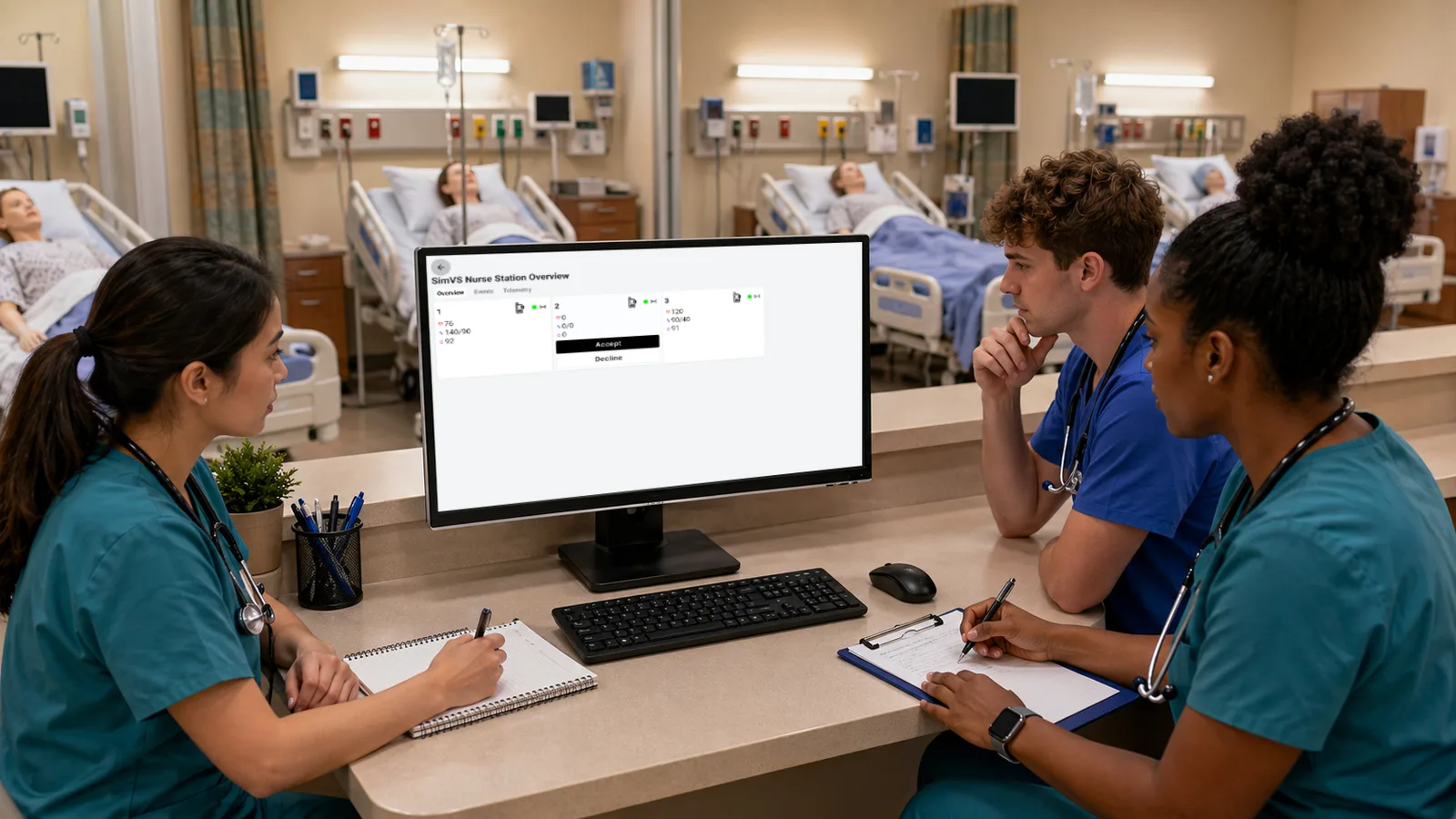
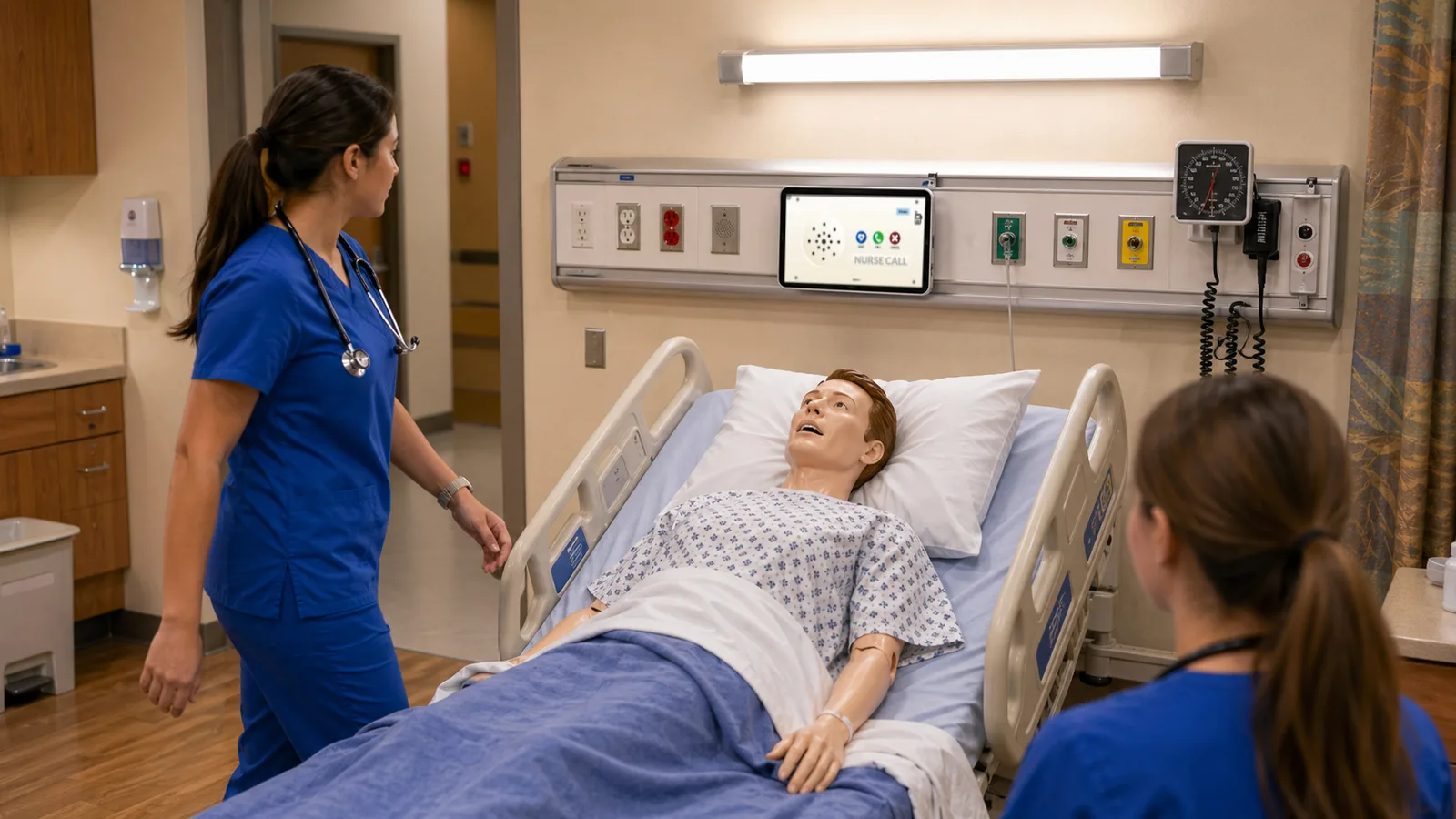
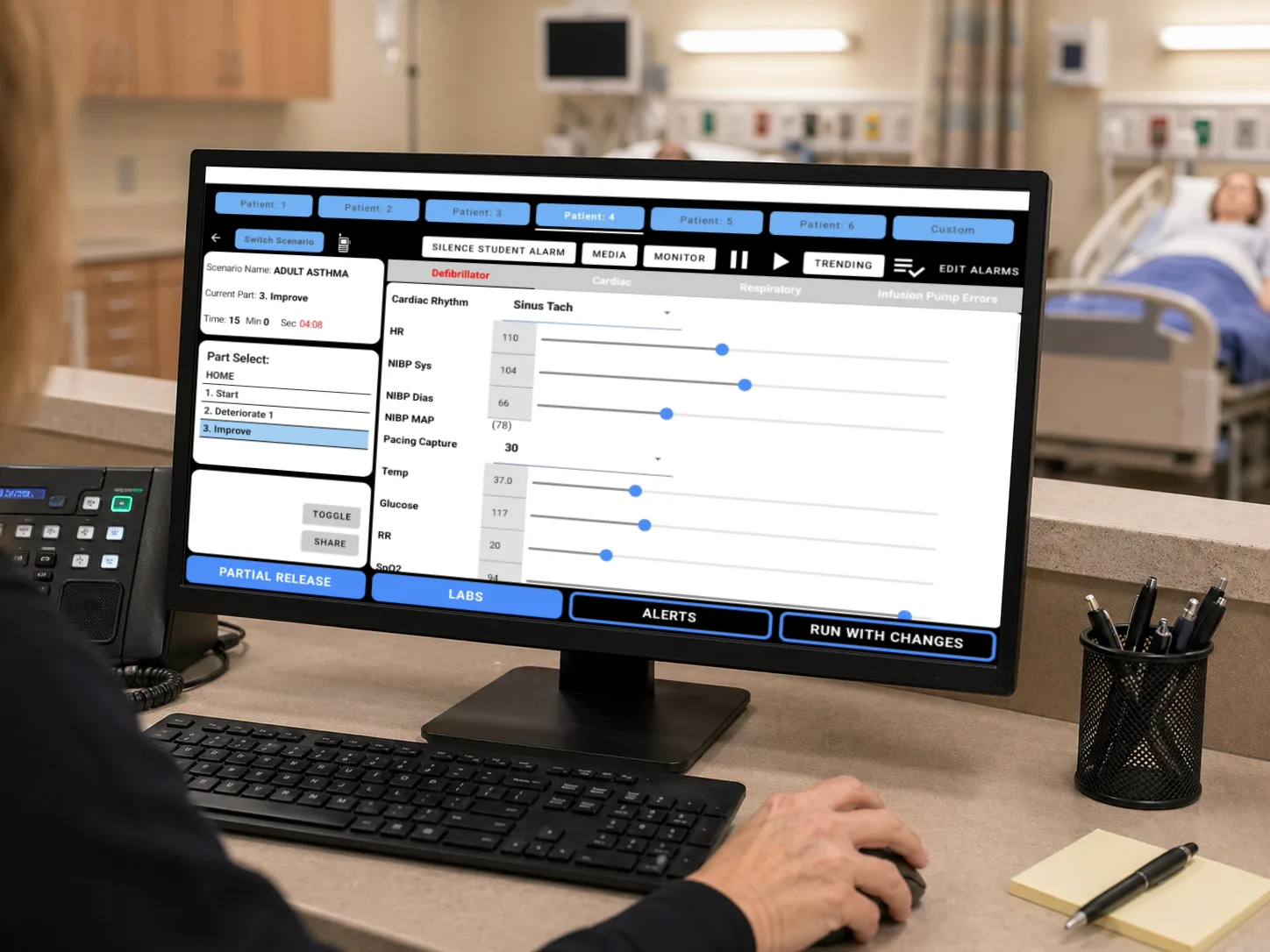
SimVS Nurse Station recreates the conditions where communication breaks down, so students can practice getting it right before it counts. It links bedside call bells, a central nurse's station display and an instructor tablet into one system, as on a real unit.
Three capabilities make it a communication trainer rather than a buzzer:
- Competing demands on cue. Instructors fire call bells, alarms and Code Blue events across multiple beds, so students must prioritize and delegate instead of handling one patient at a time.
- Live two-way audio. Instructors can speak with students at one bed or several, playing the patient, a family member or the provider on the phone. The conversation itself becomes the exercise.
- A central view with timing. The station shows active bells, Code Blue events and vital signs across the unit. It automatically logs student response times to call bells and emergencies.
We want to be clear about one thing. The system doesn't teach communication by itself; good scenario design and good debriefing do. And response time is not the goal. A fast answer to the wrong bell is a prioritization error, and a fast answer without a closed loop is still a communication failure. The timer is one input. The real measure is what students noticed, who they chose first, and what they said.
New Scenario Library
We've developed a dozen communication scenarios that target known failure patterns. All of them run on a standard Nurse Station setup with bedside Nurse Call tablets.
If you'd like to see them in action, please contact us.
See how Nurse Station could fit your lab
Talk with us about your beds, your cohort size and the scenarios you want to run.
References
- CRICO Strategies. Malpractice Risks in Communication Failures: 2015 Annual Benchmarking Report. Boston: The Risk Management Foundation of the Harvard Medical Institutions; 2015.
- Bailey M. Communication failures linked to 1,744 deaths in five years, US malpractice study finds. STAT. February 1, 2016.
- Lo L, Rotteau L, Shojania K. Can SBAR be implemented with high fidelity and does it improve communication between healthcare workers? A systematic review. BMJ Open. 2021;11(12):e055247.
- Yun J, Lee YJ, Kang K, Park J. Effectiveness of SBAR-based simulation programs for nursing students: a systematic review. BMC Med Educ. 2023;23:507.
- Starmer AJ, Spector ND, Srivastava R, et al. Changes in medical errors after implementation of a handoff program. N Engl J Med. 2014;371(19):1803–1812.
- Westbrook JI, Woods A, Rob MI, Dunsmuir WTM, Day RO. Association of interruptions with an increased risk and severity of medication administration errors. Arch Intern Med. 2010;170(8):683–690.