
Compare · SimVS vs. High-Fidelity Manikins
SimVS + Low-Fidelity Manikins vs. Mid/High-Fidelity Manikins
Do you need a high-fidelity manikin at every bed, or any manikin plus SimVS? A look at cost, fidelity, and what drives learning.
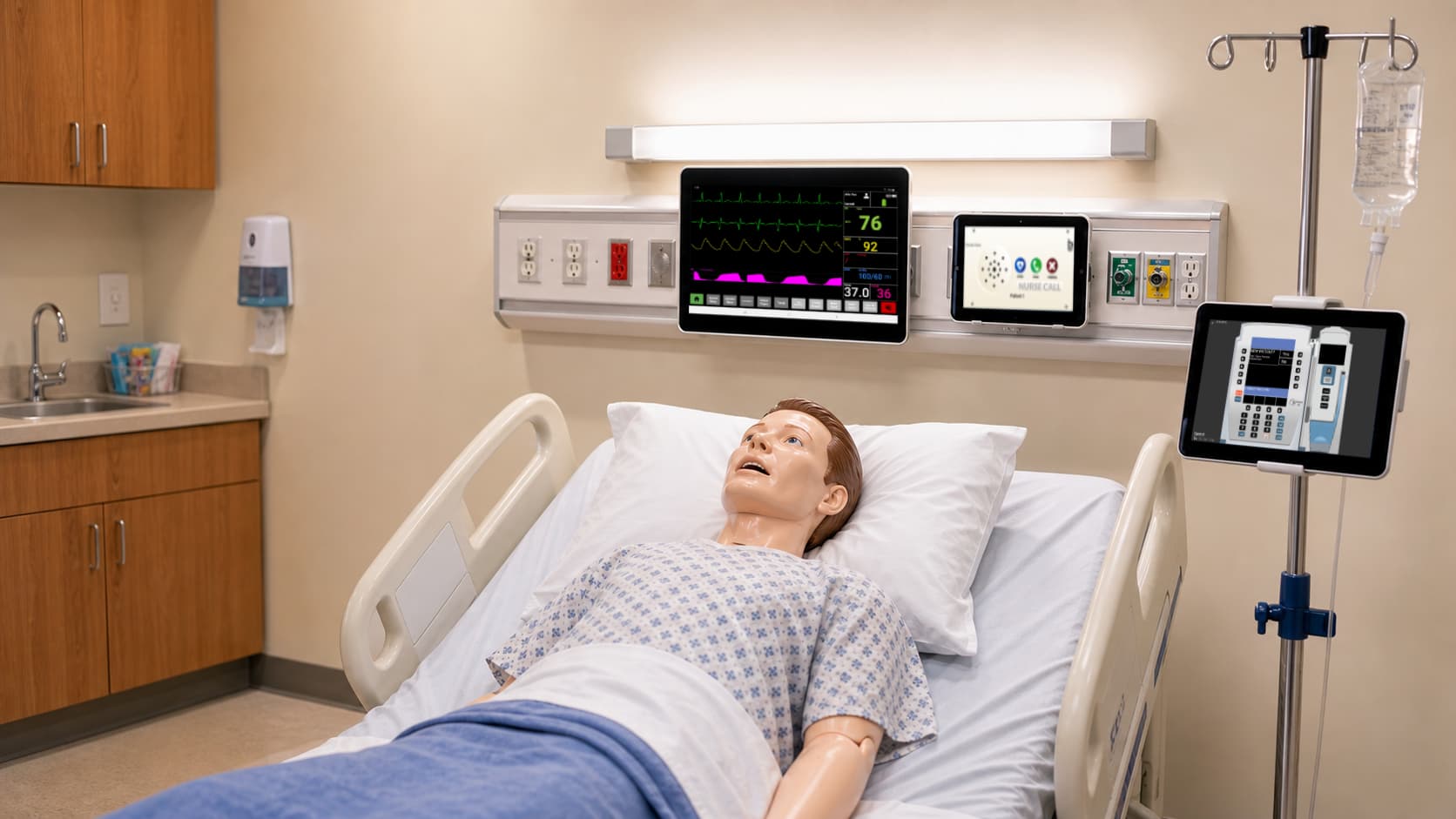
A basic manikin layered with the full SimVS device environment: patient monitor, nurse call, and IV pumps at the bedside.
High-fidelity manikins like Laerdal's SimMan, CAE, and Gaumard are capable machines, and they're priced accordingly. Before buying one for every bed, it's worth asking: what's the most cost-effective setup that meets your learning objectives?
The question isn't "SimVS or a high-fidelity manikin." It's the most cost-effective setup that meets your learning objectives.
- Choose SimVS + a basic manikin
- for monitoring, assessment, IV/medication administration, prioritization, communication, and multi-patient workflow: the realism that matters, at a fraction of the cost, across every bed instead of one.
- Choose a mid/high-fidelity manikin
- when objectives require physical physiologic responses on the body itself: palpable pulses that change, chest rise tied to ventilation, secretions, seizing, birthing. SimVS then layers onto it rather than replacing it.
At a glance
| Low-fi manikin + SimVS | Mid/High-Fidelity Manikin | |
|---|---|---|
| Typical cost | SimVS Hospital platform from $7,495 + a basic manikin (low hundreds–low thousands) | ~$10k–$100k+ per manikin depending on tier |
| Annual software license | None | Often ~$1,500–$5,000/yr (per industry cost guides) |
| Beds you can equip per $ | Many | Few |
| Realistic monitors / defib / IV | Yes (SimVS) | Often add-on or simulated separately |
| Physical body responses (pulses, breathing, secretions) | Limited (manikin-dependent) | Yes, core strength |
| Setup & maintenance | Minutes; no fluids or pneumatics | Higher; consumables, servicing, instructor certification |
| Best for | Monitoring, assessment, IV/meds, prioritization, comms, multi-patient | Mock codes, OB/birthing, high-stakes physiologic crisis, team training |
| Footprint | Light, portable; scales across a whole lab | Heavier; typically a dedicated sim room |
Higher fidelity and learning outcomes
Higher physical fidelity does not automatically produce better learning outcomes. Across the research, the level of simulation fidelity shows only a minimal relationship with transfer of learning.1
What drives learning is functional fidelity: does the scenario realistically exercise the decisions and actions the student must master? For "the monitor shows a deteriorating rhythm; what do you do, in what order, and how do you communicate it?" a tablet-driven monitor on a basic manikin is fully sufficient, and lets you run that scenario on ten beds at once. Reviews of simulation training reach the same conclusion: functional correspondence to the real task drives learning more than physical resemblance.2
Most programs don't need every bed to be high-fidelity. A common approach puts one or two high-fidelity manikins where the body matters, and SimVS on everything else.
Where high-fidelity manikins genuinely win
- Physical physiologic realism on the body. Changing pulses, breath sounds tied to ventilation, cyanosis, secretions, seizures.
- Birthing / OB and neonatal scenarios. Where the mechanism is the body itself (e.g., Gaumard's birthing simulators).
- Invasive-procedure and crisis team training. Chest tubes, difficult airway, mock codes where hands-on the body is the point.
- High-stakes, low-frequency event rehearsal. Where maximal immersion justifies the cost.
If those are your core objectives, buy the manikin, and consider SimVS to add realistic monitors, defib, and IV pumps on top of it rather than as an alternative.
Where SimVS + a basic manikin wins
- Equipping a whole lab, not one room. The same budget covers many beds.
- Bedside nursing workflow. Monitoring, assessment, IV/medication administration, nurse-call, multi-patient prioritization.
- Predictable budget. SimVS is a one-time purchase with no required annual fees, versus per-manikin software renewals and instructor-certification fees on high-fidelity systems.
- Low maintenance & fast turnover. Minutes to set up, no pneumatics or consumables, easy for adjunct faculty.
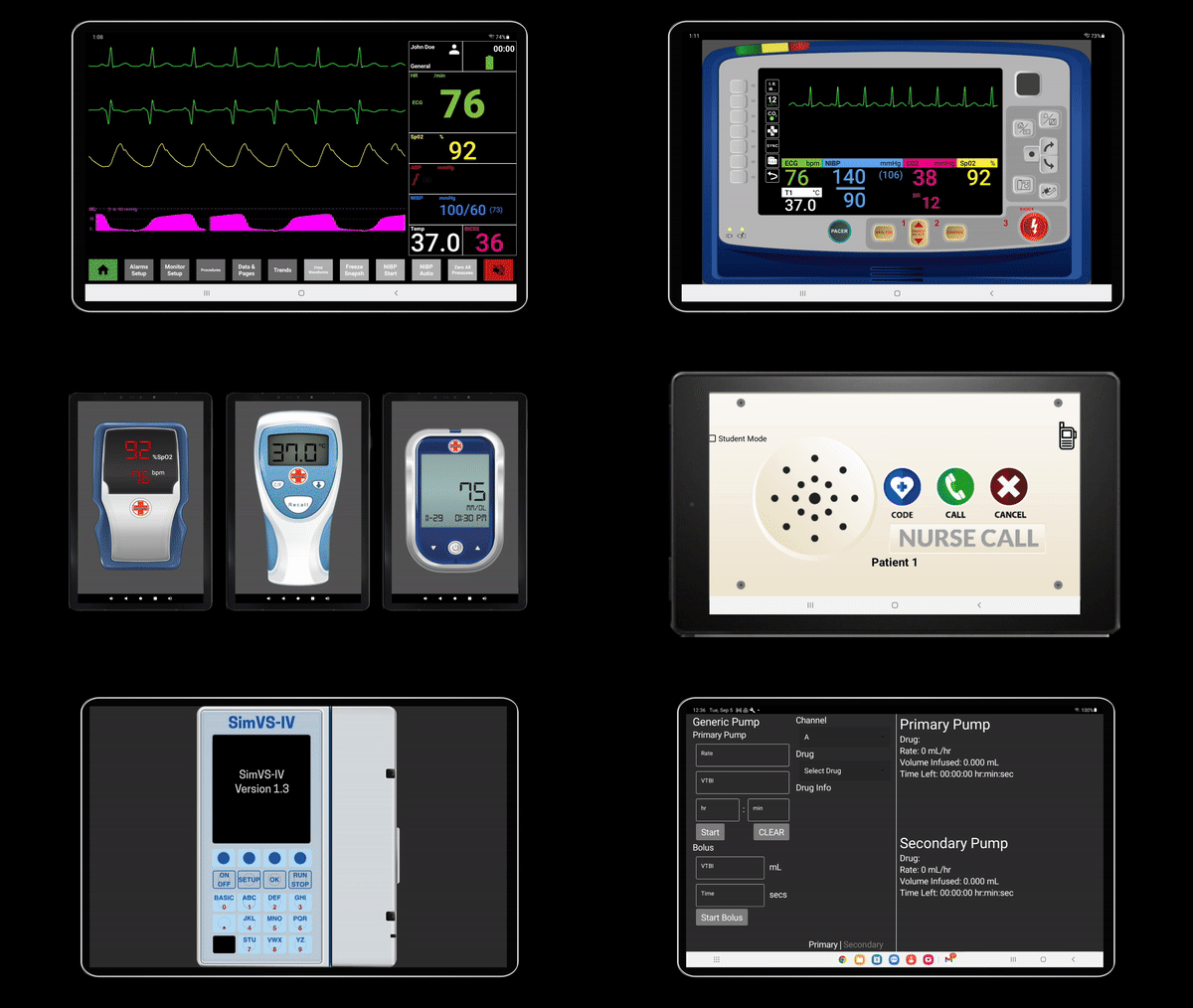
- One platform across the entire workflow. SimVS simulates the whole clinical environment (IV pumps, patient monitors, defibrillator, ventilator, fetal monitor, and a multi-patient nurse station), so one integrated system carries your full nursing workflow across every bed.
- Works with the manikins you already own. Partner SimVS with any low- or mid-fidelity manikin to create a high-fidelity experience, or layer modern monitor/defib/IV interfaces onto a high-fidelity manikin with dated interfaces.
"SimVS vs. Laerdal": how to read the brand comparison
When people search "SimVS vs. Laerdal" (or CAE, or Gaumard), they're usually really asking one of two things:
- "Can I avoid spending $70k on a SimMan?" Often yes, if your objectives are monitoring/assessment/meds rather than physical-body responses. SimVS on a basic manikin covers a lot of that ground.
- "I already own a SimMan, so what does SimVS add?" Modern, swappable monitor, defibrillator, and IV-pump interfaces layered onto the manikin you already have, plus a multi-patient nurse-station model around it.
Laerdal/CAE/Gaumard and SimVS are not mutually exclusive. The most common real-world answer is "both, deployed where each makes sense." Because SimVS is a tablet-based ecosystem that runs alongside any manikin, one platform can carry the entire nursing workflow across your lab while your high-fidelity manikins do what only they can.
A common way to spend a limited budget
One or two high-fidelity manikins for the scenarios that need a responsive body, and SimVS across the rest of your beds so every station has realistic monitors, defib, and IV pumps.
Frequently asked
Is SimVS a replacement for a Laerdal SimMan?
How much does a high-fidelity manikin cost vs. SimVS?
Does higher fidelity mean better learning outcomes?
Can I use SimVS with my existing manikins?
How should we spend a limited sim budget?
See whether SimVS covers your objectives
See it run on a basic manikin, or alongside the high-fidelity manikins you already own.
References
- Norman G, Dore K, Grierson L. The minimal relationship between simulation fidelity and transfer of learning. Medical Education, 2012;46(7):636-647. https://pubmed.ncbi.nlm.nih.gov/22616789/
- Hamstra SJ, Brydges R, Hatala R, Zendejas B, Cook DA. Reconsidering fidelity in simulation-based training: a meta-analytic approach. Academic Medicine, 2014;89(3):387-392. https://pubmed.ncbi.nlm.nih.gov/24448038/
- Manikin cost and license ranges per published industry cost guides: HealthySimulation, "Human Patient Simulator Cost," https://www.healthysimulation.com/human-patient-simulator-cost/; HealthySimulation, "Laerdal SimMan," https://www.healthysimulation.com/simman/; MedVision, "Medical Manikin Price Guide," https://medvisionsim.com/blog/medical-manikin-price-guide.
- SimVS Summer 2026 Catalog and product information. https://www.simvs.com/