
Compare · Manikin + SimVS
Your High-Fidelity Manikin: Alone vs. With SimVS
You already own the manikin. Here's what SimVS layers on top (IV pumps, nurse call, a ventilator, modern monitor and defibrillator interfaces, and a multi-patient nursing unit) without replacing what the manikin does best.
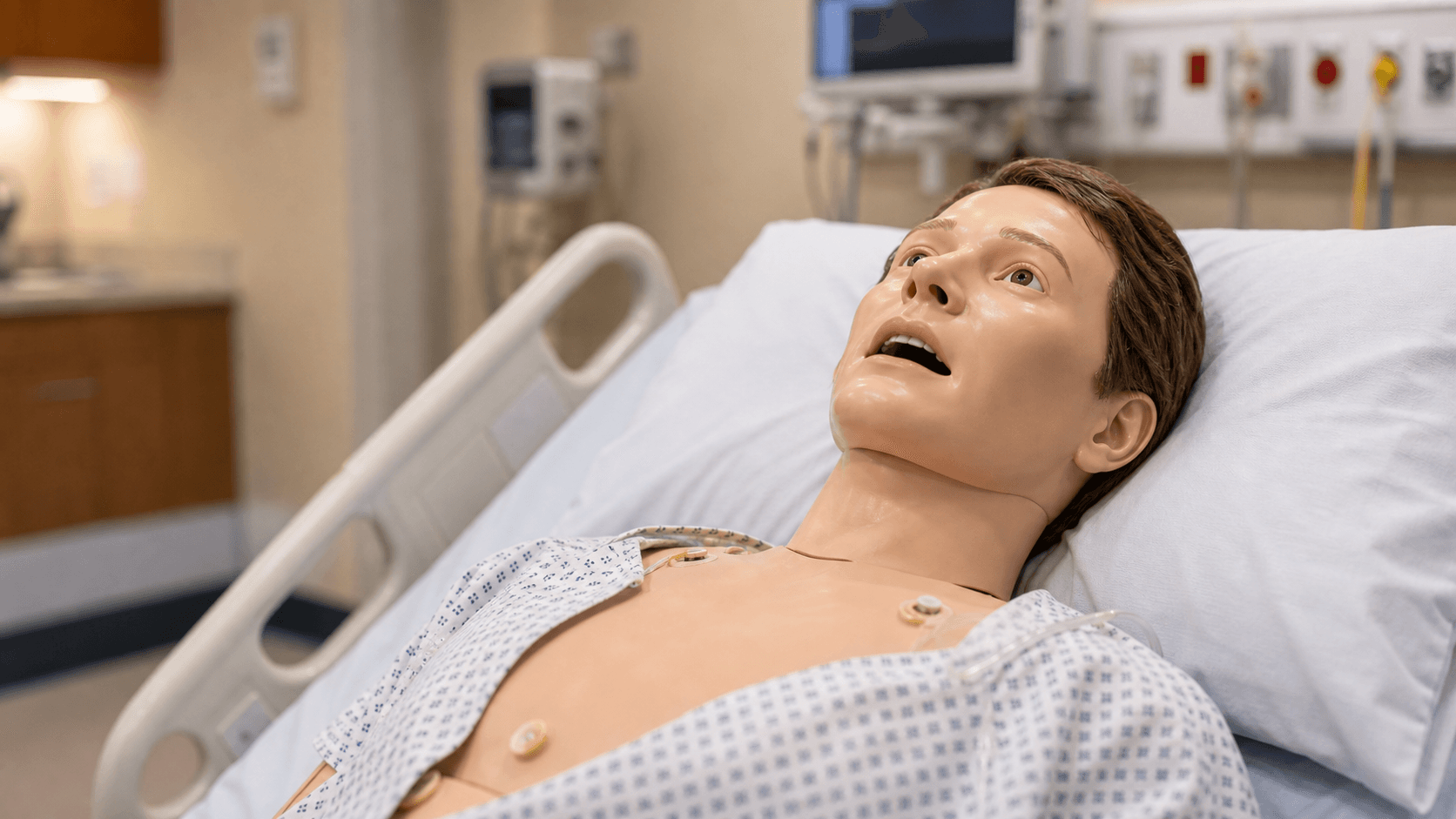
A high-fidelity manikin at the bedside: the foundation SimVS layers a full device environment onto.
A high-fidelity manikin (Laerdal SimMan, CAE, Gaumard) is built to reproduce the physical body: palpable pulses that change, breath sounds tied to ventilation, secretions, seizures, birthing. What it usually does not include is the rest of the clinical environment around the bed. That's the gap SimVS fills.
The manikin and SimVS aren't rivals. The manikin owns the physical body, and SimVS surrounds it with the devices and workflow that happen around the bed.
- Choose SimVS to add around the manikin
- when your objectives reach past the body into monitoring, IV pumps, medication administration, nurse-call workflow, and multi-patient prioritization. It runs on tablets you already own, with no subscription.
- Choose to keep the manikin alone
- if your scenarios only exercise the manikin's physical responses and its built-in monitor already meets your objectives. There may be nothing to add at that station.
At a glance
| Manikin + SimVS | High-fidelity manikin alone | |
|---|---|---|
| Physical body responses (pulses, breath sounds, secretions, birthing) | Unchanged, still the manikin's job | Yes, core strength |
| Patient monitor | Large library of modern monitor types, 200+ waveforms | Built-in, sometimes dated or limited |
| Defibrillator | 2 interfaces (LP-15 and X-Series), plus AED mode | Varies by model |
| IV infusion pumps | 6 pump interfaces: Alaris, Baxter, Infusomat, Plum, PCA, generic | Not typically included |
| Ventilator | Realistic ventilator interface | Varies or add-on |
| Fetal monitor | Fetal monitor interface | OB models only |
| Point-of-care devices | Glucometer, pulse oximeter, thermometer on one tablet | Not typically included |
| Nurse call | Simulated nurse call on any headwall | No |
| Multi-patient | Nurse Station, up to 20 beds | One bed |
| Runs on | iPad, Android, Windows, Mac, Chromebook | Proprietary hardware |
What the manikin already does well
Physical fidelity on the body is genuinely hard to fake, and it is where a high-fidelity simulator earns its price:
- Body responses that change in real time. Pulses that weaken or disappear, breath sounds that change with ventilation, cyanosis and secretions.
- Birthing and neonatal mechanics. Scenarios where the body itself is the teaching tool.
- Invasive-procedure and crisis work. Chest tubes, difficult airway, mock codes, where hands on the body is the point.
None of that changes when you add SimVS. The manikin keeps doing what it does best; SimVS builds the rest of the bedside around it.
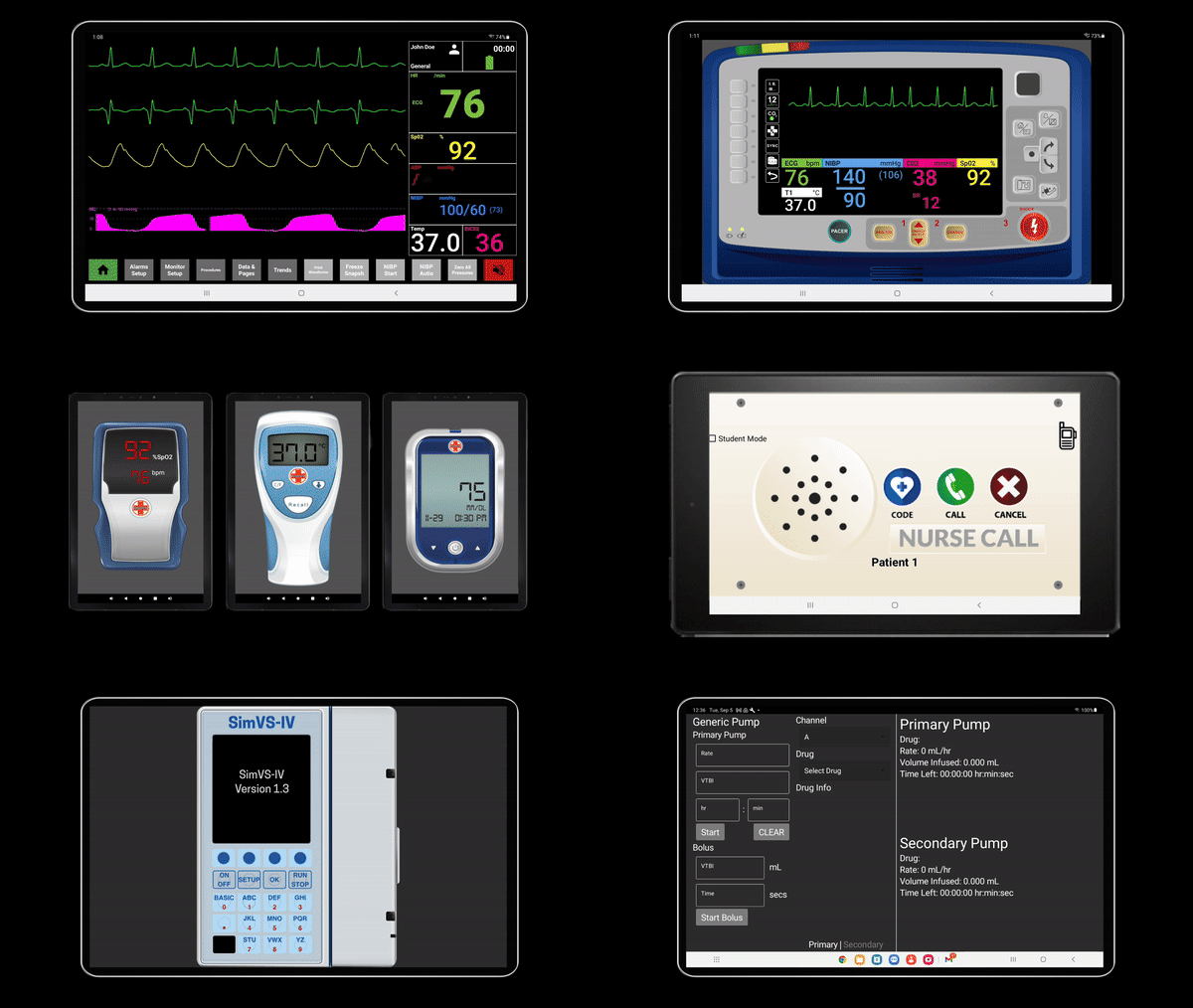
What SimVS adds
SimVS builds a complete bedside around the manikin, layering on the devices and clinical workflow the body alone can't cover:
- IV infusion pumps. SimVS-IV puts six pump interfaces (Alaris, Baxter, Infusomat, Plum, a PCA pump, and a generic pump) on a tablet at the bedside, so students program infusions, catch errors, and respond to alarms, something the manikin doesn't do.
- Modern monitor and defibrillator interfaces. A large library of patient monitors with 200+ waveforms, plus two defibrillator interfaces (the LP-15 and the X-Series) and an AED mode, layered over a manikin whose built-in screens may be dated or limited.
- Ventilator and fetal monitor. Realistic interfaces for each, added to scenarios the manikin can't display on its own.
- Point-of-care devices. A point-of-care tablet that doubles as a glucometer, pulse oximeter, and thermometer, capturing glucose, SpO2, and temperature at the bedside.
- Nurse call. A simulated nurse-call system that installs on any headwall. The instructor pushes alarms and calls to the student tablet, and students accept, decline, and communicate, building the interruption-driven multitasking real bedside nursing demands.
- A multi-patient unit. The SimVS Nurse Station turns a single high-fidelity room into one bed within a unit of up to 20, so students practice prioritization and delegation across patients, not just one.
Functional fidelity, how well a scenario exercises the real tasks and environment, drives learning more than the physical realism of the body alone.
Because the manikin handles the physical body and SimVS adds the environment around it, a simulator you already own becomes a far more complete bedside. Simulation research supports this pairing (Hamstra et al., 2014; Norman et al., 2012).
Where you may not need to add anything
Augmentation isn't always necessary. The case for adding SimVS is strongest when your objectives reach past the body: into monitoring, medication administration, IV pumps, nurse-call workflow, and multi-patient prioritization, the parts of nursing that happen around the bed.
When you may not need it
If your scenarios only exercise the manikin's physical responses, and its built-in monitor already meets your objectives, you may not need to add SimVS to that station. SimVS is tablet-based: it reproduces device screens, controls, and behavior, so it complements the manikin rather than replacing what it does.
Frequently asked
Does SimVS replace my high-fidelity manikin?
What can SimVS add that my manikin can't do?
Will it work with my SimMan, CAE, or Gaumard manikin?
Do I have to replace the manikin's built-in monitor?
What does it run on?
Already own a high-fidelity manikin? See what SimVS adds around it.
Add SimVS on the tablets you already own. The SimVS-IV pump simulator is also available as a free trial.
References
- SimVS Summer 2026 Catalog (SimVS-IV six pump interfaces incl. PCA; large patient-monitor library with 200+ waveforms; ventilator and fetal monitor interfaces; partners with any low- or mid-fidelity manikin; runs on iPad, Android, Windows, Mac, and Chromebook). simvs.com
- SimVS EMS Series (LP-15 and X-Series defibrillator interfaces). simvs.com/products/ems-series
- SimVS Smart Headwall and Nurse Call System (simulated nurse call that installs on any headwall; instructor sends alarms to the student tablet for students to accept or decline). simvs.com
- Hamstra SJ, Brydges R, Hatala R, Zendejas B, Cook DA. Reconsidering fidelity in simulation-based training: a meta-analytic approach. Academic Medicine, 2014;89(3):387-392.
- Norman G, Dore K, Grierson L. The minimal relationship between simulation fidelity and transfer of learning. Medical Education, 2012;46(7):636-647.