
Compare · Nurse Station vs. DIY
SimVS Nurse Station vs. DIY Multi-Patient Scenarios
Buy a ready-to-run multi-patient curriculum and the unit infrastructure to deliver it, or build the scenarios (and the environment) yourself?
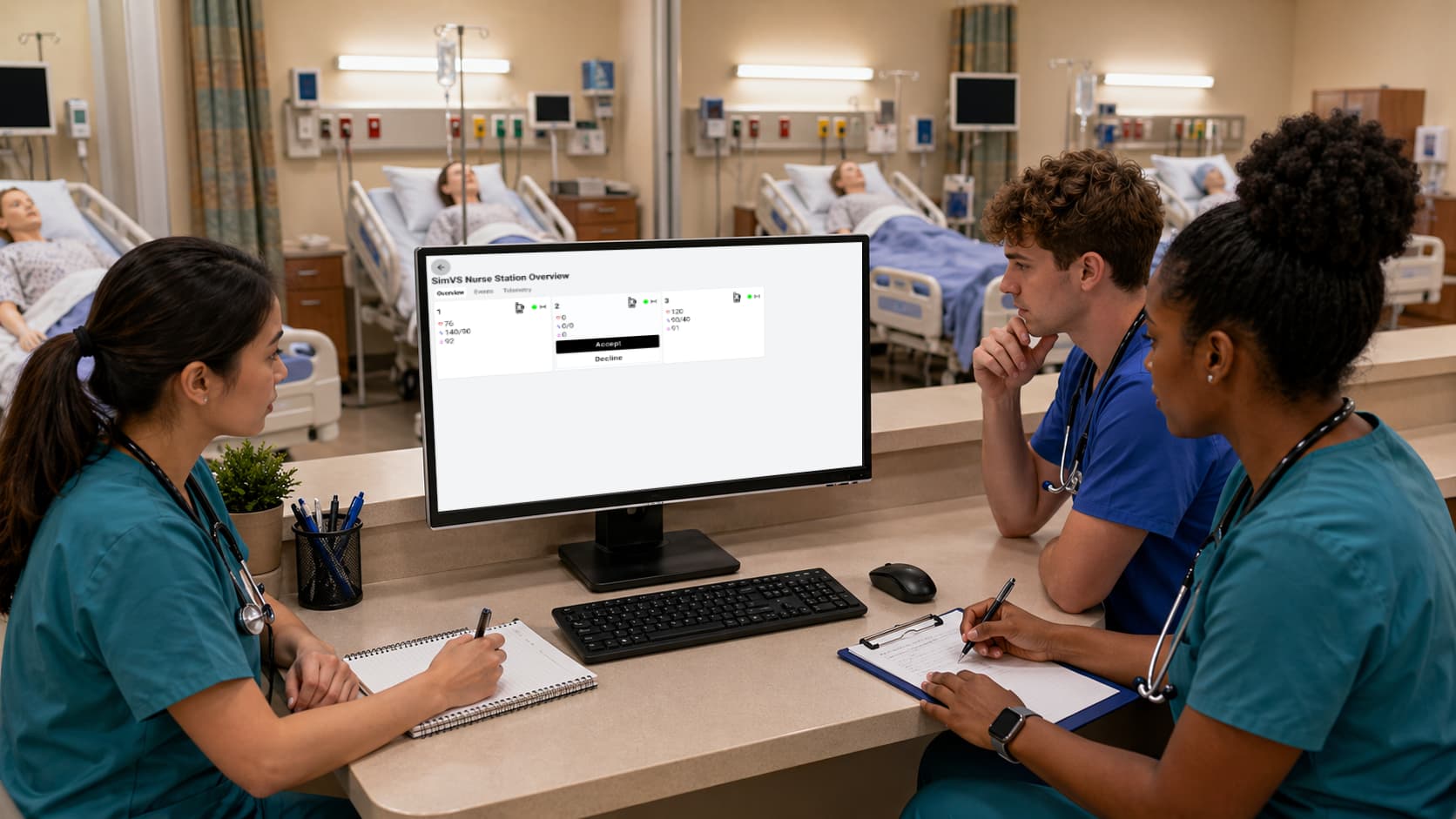
Nursing students monitoring a multi-patient unit from the SimVS Nurse Station hub.
How multi-patient simulation works
Follow a patient call through the Nurse Hub and bedside assessment. When a second patient calls, the student has to prioritize — the workflow behind the curriculum and unit infrastructure compared below.
Nurse Station workflow explainer. Door Alarm and SimVS EHR are optional add-ons.Teaching prioritization, delegation, and clinical judgment takes more than one patient. It takes a whole nursing unit: several patients with competing needs, call bells going off, and a student deciding what happens first. Every nursing student should have access to multi-patient simulation, but should you build it yourself or buy it ready to run?
Building your own gives you the experience of creating a system if you are rich in faculty time; the Nurse Station gives that time back, an NCLEX-aligned curriculum, and a real multi-patient environment.
- Choose the SimVS Nurse Station
- if you want 16 faculty-authored, NCJMM-aligned scenarios that combine into 100+ ready-to-run multi-patient combos, plus the infrastructure to run a unit (bedside call bells, telemetry, two-way communication, up to 20 beds from one hub) without spending a semester building it.
- Build your own (DIY)
- if you have the faculty time to author and validate scenarios, and already have a way to run multiple beds at once.
At a glance
| SimVS Nurse Station | Build your own (DIY) | |
|---|---|---|
| Scenario library | 16 faculty-authored scenarios, 100+ ready-to-run combos | You author each one from scratch |
| Clinical-judgment alignment | NCJMM-aligned out of the box | You map each scenario to a framework yourself |
| Patients per scenario | 2, 3, or 4 simulated patients | Whatever you build and can staff |
| Build time | None to build; ~2 hours prep-to-debrief per combo | “Hundreds of hours” to write, chart, pilot, and revise |
| Authored by | Dr. Teresa Gore and Dr. Elizabeth Robison | Your faculty |
| Multi-patient environment | Call bells, telemetry, two-way comms, real-time alerts | Improvised, usually manual |
| Scale | Up to 20 beds per hub; Lab 6 Pack for a full unit | Limited by your setup and faculty bandwidth |
| Customization | SimVS Scenario Builder to edit or add your own | Total; you own everything |
| Cost | One-time purchase (or upgrade an existing SimVS system); no required annual fees | No software cost; faculty time is the real cost |
| Best for | Programs that want clinical-judgment and NCLEX readiness fast | Programs with niche needs and faculty time to build |
What building your own really costs
Building your own multi-patient simulation is two jobs. The first is content: writing each scenario, its charts and orders, how each patient evolves, and the cues students must catch, then piloting and revising it. SimVS estimates a comparable library is “hundreds of hours of build time.” The second is the environment: a realistic multi-patient unit, not just one manikin. Prioritization and delegation only get exercised when several patients compete for attention at once, call bells interrupt, and telemetry needs watching. Building that yourself means cobbling together call systems, monitors, and communication tools.
And those hundreds of hours come from people who do not have them. Scenario authoring is not a one-time inconvenience; it is faculty time pulled from teaching, clinical supervision, and the students themselves.
The faculty time isn't there to spare
An AACN nurse faculty-vacancy survey found a 7.2% national vacancy rate across 863 schools, and separate AACN enrollment data reported that 80,162 qualified applications were turned away in 2024, with faculty shortages among the leading reasons. About a third of the nursing faculty workforce was projected to retire by 2025. Every hour spent authoring homemade scenarios is an hour a short-staffed department can't spend elsewhere.
The SimVS Nurse Station covers both jobs. It includes the ready-made curriculum (16 faculty-authored, NCJMM-aligned scenarios that combine into 100+ multi-patient combos) plus the unit infrastructure to run it: call bells, telemetry, an instructor hub, two-way communication, and real-time alerts across up to 20 beds, handing capacity back to a department that has none to spare.
Why “NCJMM-aligned” matters here
The included curriculum is aligned to the NCSBN Clinical Judgment Measurement Model (NCJMM), the framework behind the Next Generation NCLEX. NCJMM describes clinical judgment as six steps: recognize cues, analyze cues, prioritize hypotheses, generate solutions, take action, and evaluate outcomes.
Those steps map directly onto multi-patient work. When a student has to decide which of four patients to see first, weighing each one's acuity as a call bell rings, they're exercising “recognize cues,” “analyze cues,” and “prioritize hypotheses,” all in real time. Because nursing-education faculty wrote the included scenarios against NCJMM, you don't have to reverse-engineer prioritization and delegation into homemade cases.
Prioritization and delegation only get exercised when several patients compete for attention at once. That's the environment, not just the scenario.
Where building your own still makes sense
The DIY route wins on a couple of real things:
- No platform purchase. If capital budget is the hard constraint and faculty time is available, paper-based or improvised multi-patient exercises cost nothing up front.
- Faculty development. Authoring scenarios builds genuine expertise in your team.
What the Nurse Station includes
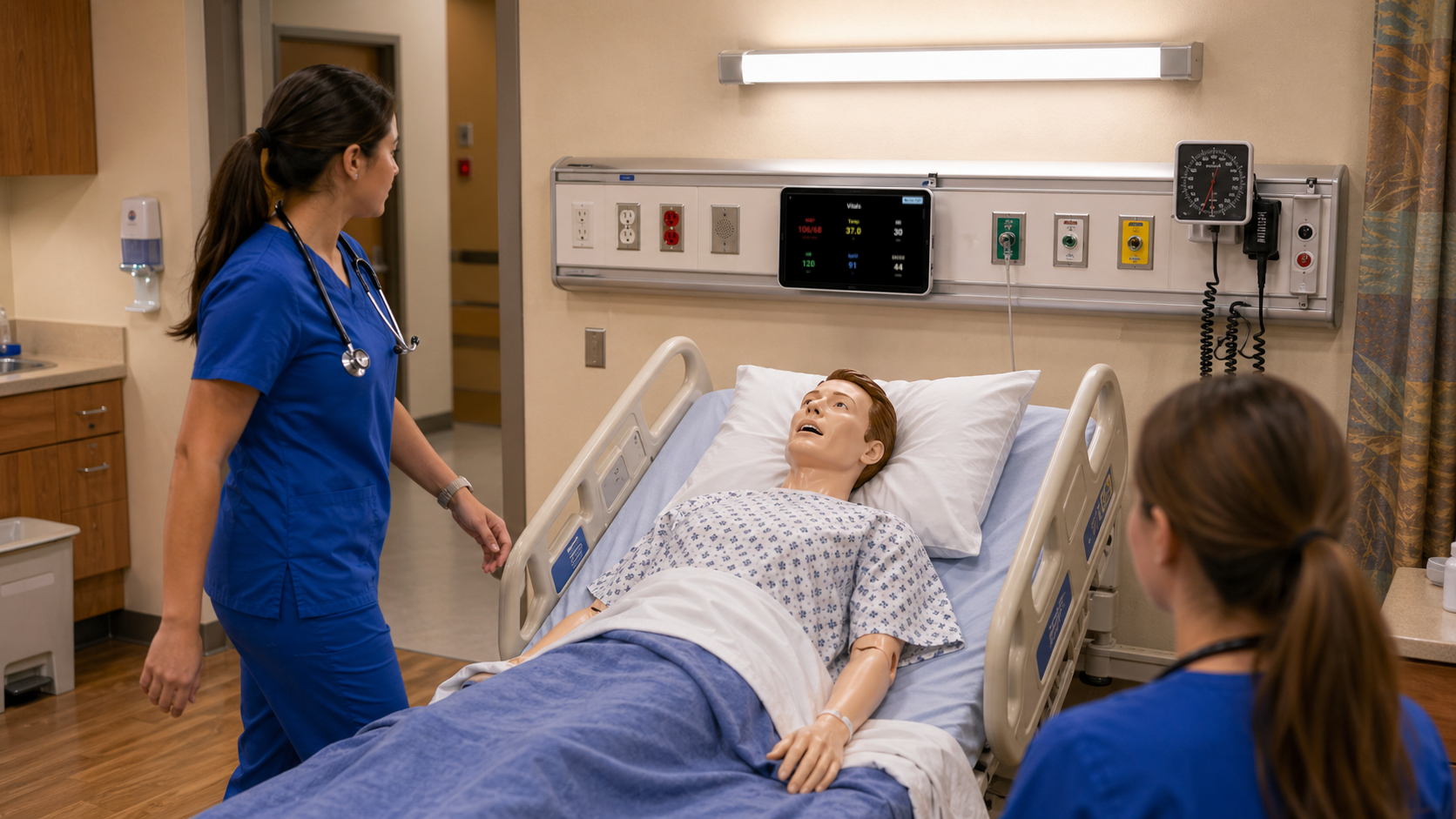
- SimVS Nurse Station. Bedside call bells, a central nurse's-station device, and an instructor tablet in one plug-and-play system, with no wiring or installation.
- Multipatient Curriculum (included, Edition 2026.1). 16 faculty-authored, NCJMM-aligned scenarios that combine into 100+ multi-patient combos, run as 2, 3, or 4 patients at a time, at about 2 hours prep-to-debrief.
- Facilitator binder. A printed guide with an SBAR handoff for each patient and branching transitions where each patient's condition improves or deteriorates based on how the student prioritizes care.
- Instructor control. Send alerts and vitals, view call-bell status, and monitor student responses across up to 20 beds per hub.
- Bedside. Respond to alerts, call a code blue, push-to-talk communication, and toggle between nurse call and vitals.
- Point-of-care devices. A point-of-care tablet that doubles as a glucometer, pulse oximeter, and thermometer, capturing glucose, SpO2, and temperature at the bedside with an easy switch between device types.
- Nurse Station Lab 6 Pack. A full-unit configuration for programs running 6 or more beds.
- No required annual fees. Generally released updates are included for supported systems, and existing SimVS systems can be upgraded to the Nurse Station.
Frequently asked
Can't our faculty just write their own multi-patient scenarios?
What does “NCJMM-aligned” mean?
How many scenarios are included, and how big are they?
Can we still customize or add our own scenarios?
How many beds can it run?
Is there an annual fee?
Who wrote the curriculum?
See a full unit of patients run itself
Run the 16-scenario curriculum on a real multi-patient environment, without spending a semester building it.
References
- SimVS Summer 2026 Catalog (SimVS Nurse Station; Multipatient Curriculum, Edition 2026.1: 16 NCJMM-aligned scenarios combining into 100+ multi-patient combos, 2 to 4 patients, developed by Dr. Teresa Gore and Dr. Elizabeth Robison). https://www.simvs.com/
- NCSBN, Clinical Judgment Measurement Model and the Next Generation NCLEX. https://www.ncsbn.org/
- American Association of Colleges of Nursing (AACN), Nursing Faculty Shortage Fact Sheet, 2025 — 7.2% national nurse faculty vacancy rate across 863 schools. https://www.aacnnursing.org/news-data/fact-sheets/nursing-faculty-shortage
- American Association of Colleges of Nursing (AACN), enrollment and admissions data — 80,162 qualified applications turned away in 2024. https://www.aacnnursing.org/news-data