
Compare · SimVS vs. VR Simulation
SimVS (Tablet-Based) vs. VR Simulation
Hands-on device and bedside training on the manikins you already own, or fully immersive headset scenarios? A look at where each fits, and why many programs use both.
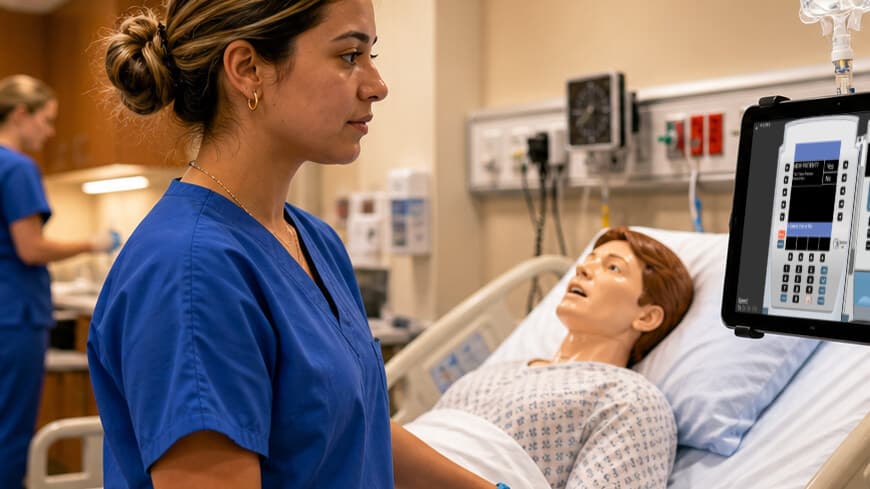
SimVS runs real device interfaces on a tablet at a real bedside — no headset required.
These are two different kinds of “realism.” Virtual reality platforms (UbiSim, Oxford Medical Simulation, SimX, VRpatients) deliver immersive realism: the student puts on a headset and is inside a virtual scene. SimVS delivers physical, hands-on realism: real device interfaces on a tablet, used on the manikins, standardized patients, and task trainers already in your lab.
VR is strongest at putting students inside a scene; SimVS is strongest at putting real equipment in their hands, and the research shows the two are complementary, not interchangeable.
- Choose SimVS for hands-on competence
- operating real devices and equipment, practicing bedside and multi-patient workflow, and building muscle memory on the manikins you already own, with no headsets to buy or manage.
- Choose VR for immersion
- when the goal is putting students inside environments that are hard to stage: a disaster scene, a moving ambulance, a rare crisis.
At a glance
| SimVS (tablet-based) | VR simulation (headset) | |
|---|---|---|
| Approach | Real device interfaces on tablets, layered on manikins and SPs | Fully virtual, immersive headset environment |
| Hands-on psychomotor skills | Hands on real equipment | Controllers or hand-tracking; don’t replace real tactile feedback |
| Environments | Your physical lab and bedside | Any scene, including ones hard to stage (disaster, prehospital) |
| Immersion / sense of presence | Physical-room realism | High immersion and presence |
| Remote / distance learning | Yes, on any tablet, anywhere | Yes, but needs a headset |
| Hardware | Tablets you already own: iPad, Android, Windows, Mac, Chromebook | A headset per learner, plus charging, management, and sanitation |
| Cybersickness / accessibility | None | Documented for some learners (nausea, dizziness) |
| Works with existing manikins | Yes, layers onto them | Replaces the physical scene |
| Pricing | One-time purchase, no required annual fees | Typically subscription or per-learner licensing, plus headset hardware |
| Best for | Hands-on device and bedside skills, equipment familiarity, team sim in a real room | Immersive scenes and hard-to-stage environments |
Where VR genuinely wins
VR is a real and valuable tool, and it does things a tablet on a manikin simply can’t. When immersion is the objective, a headset is hard to beat.
- Environments you can’t stage. A multi-casualty scene, a roadside extrication, a rare crisis: VR builds the whole world around the student.
- Immersion and presence. A well-built headset scenario creates a strong sense of “being there,” which drives engagement.
- Repeatable, standardized scenes. Every student gets the identical environment, independent of lab space or props.
Where SimVS (tablet-based) wins
SimVS is built for the other half of the problem: getting real equipment into students’ hands in a real room.
- Hands on real equipment. Students touch actual devices and manikins: program a real pump interface, run a real defibrillator interface, perform real assessment and procedures with their own hands rather than handheld controllers.
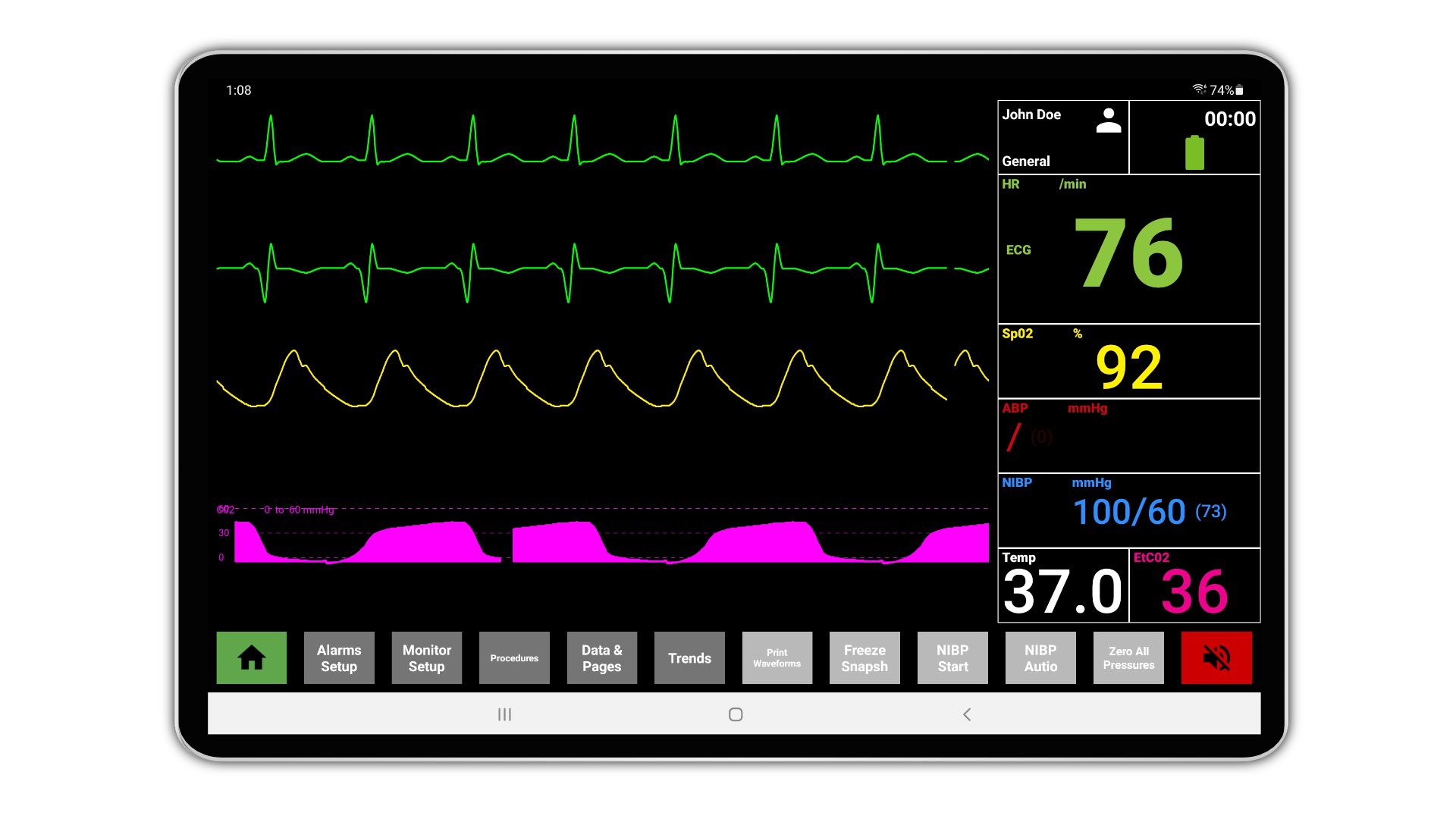
- Works with what you own. SimVS layers realistic monitors, defibrillators, IV pumps, a ventilator, a fetal monitor, and a nurse-call system onto the manikins, standardized patients, and task trainers already in your lab.
- No headsets to buy or manage. It runs on iPad, Android, Windows, Mac, and Chromebook, with no per-learner headsets to purchase, charge, sanitize, or troubleshoot, and no cybersickness barrier.
- Real team interaction. Students communicate face to face in a physical room, the way a real unit works, including multi-patient prioritization through the Nurse Station.
- Predictable budget. A one-time purchase with no required annual fees, versus the subscription-plus-hardware model typical of VR.
What the research says
The nursing-education literature lands in a consistent place: VR is valuable, and it works best alongside hands-on training rather than instead of it.
- VR raises knowledge and engagement. Studies find VR can improve knowledge, confidence, motivation, and satisfaction, and recommend it as a complement to skills labs rather than a replacement for them.
- Complex psychomotor skills are harder in VR. Controllers and hand-tracking don’t replace real tactile feedback, so physical practice still leads for hands-on competence.
- Cybersickness limits some learners. Nausea, dizziness, and disorientation affect a meaningful share of learners and can limit session length and who can participate.
If the research says VR should complement a hands-on skills lab, SimVS is that hands-on layer: real devices and real equipment on the manikins you already own.
That is precisely the gap SimVS fills. Many programs are best served using both: VR for immersive scenes, SimVS for hands-on device and bedside competence.
Not either/or
VR and tablet-based simulation solve different problems. Treating them as rivals forces a choice the evidence doesn’t require; the strongest labs pair immersive scenes with hands-on equipment practice.
Frequently asked
Is SimVS a VR system?
Is SimVS less immersive than VR?
Should we choose SimVS or VR?
What about cost and setup?
Does VR replace skills labs?
Real devices in your students’ hands, on the manikins you already own
See SimVS running on your own tablets, with no headsets to buy, charge, or sanitize.
References
- SimVS Summer 2026 Catalog (tablet-based platform; runs on iPad, Android, Windows, Mac, and Chromebook; layers onto any manikin or standardized patient; device interfaces including SimVS-IV, patient monitors, defibrillators, ventilator, fetal monitor, and Nurse Station; one-time purchase, no required annual fees). simvs.com.
- “My hands are running away: learning a complex nursing skill via virtual reality simulation,” a randomised mixed-methods study. BMC Nursing, 2023 (psychomotor skill acquisition in VR). https://www.ncbi.nlm.nih.gov/pmc/articles/PMC10294322/
- “Two important factors in virtual reality simulations: Nursing students’ experiences of cybersickness and sense of presence,” Clinical Simulation in Nursing, 2025. https://www.sciencedirect.com/science/article/abs/pii/S1876139925001045