Nursing Education
MUSC Nursing Students Passed Dosage Calculation at 87.5%. Here's What Changed.
A peer-reviewed study from the Medical University of South Carolina tests whether tablet-based IV pump simulation in pathopharmacology can close the theory-to-practice gap in medication safety.
Peer-reviewed evidence from the Medical University of South Carolina showing how tablet-based IV pump simulation changed dosage calculation pass rates and student confidence in a second-semester accelerated BSN pathopharmacology course.
By SimVS Research Team

Key Insight
The gap between dosage calculation on paper and programming a real IV pump is where medication errors start. A new peer-reviewed study from the Medical University of South Carolina shows that simulated IV pumps in the classroom can close it before students ever reach clinicals.
The Problem Nursing Education Has Been Working Around
Medication safety is a core nursing competency. Dosage calculation is the foundation of that competency. And yet, up to half of new graduate nurses are involved in health-care-related errors, the statistic the MUSC authors cite to frame the urgency around medication-safety education.
The reason isn't a mystery. Traditional nursing education teaches dosage calculation as a paper-and-pencil skill. Students solve problems on worksheets, pass an exam, and then encounter a real infusion pump for the first time in a clinical rotation. By that point, the mental model they built in class has to be rapidly translated into a piece of equipment they have never actually touched.
The 2025 Joint Commission National Patient Safety Goals name accurate medication administration as one of the most important safety priorities in acute care. The American Association of Colleges of Nursing's Essentials framework, Domain 5, names quality and safety as a core competency area and specifically calls out dosage calculation and safe administration. Both documents assume nursing programs are closing the theory-to-practice gap. Most programs don't have a scalable way to do it.
That's the gap Terzulli, Bachir, and Smith set out to close at MUSC.
What the MUSC Team Measured
The research team integrated tablet-based simulated IV pumps into their second-semester accelerated BSN (ABSN) pathopharmacology course. Students completed the same dosage calculation curriculum their prior cohorts had completed, but alongside each calculation they also programmed the result into a tablet-running simulated infusion pump interface. The calculation and the programming were taught together.
Two cohorts sit at the center of the study:
- Spring 2025 (control cohort): N=96 students. Traditional curriculum. No tablet-based pump integration.
- Summer 2025 (intervention cohort): N=88 students. Same curriculum, plus integrated tablet-based simulated IV pumps.
The primary outcome was the first-time pass rate on the course dosage calculation exam. A secondary outcome, collected via a voluntary confidence survey, asked students to rate how confident they felt programming continuous IV infusions before and after the intervention.
The Finding
First-Time Pass Rate · Dosage Calculation Exam
Control · Spring 2025
76%
N = 96 students
Intervention · Summer 2025
87.5%
N = 88 students
First-time pass rate on the dosage calculation exam rose from 76% in the control cohort to 87.5% in the intervention cohort. Across 88 students, the simulated IV pump integration moved the needle by more than eleven percentage points on the course's primary knowledge assessment.
That's the paper's primary outcome. The authors note the difference did not reach statistical significance in a t-test on mean scores (p=.09) and recommend replication across larger cohorts before generalizing. What the comparison does show is a consistent directional signal on the outcome the course was designed to measure.
The secondary outcome on confidence tells a more textured story. In the pre-intervention confidence survey, 63% of students said they were "not confident" programming a continuous IV infusion. Post-intervention, that fell to 21.4%. Students who said they were at least "somewhat confident" rose from 37% pre-intervention to 78.6% post-intervention.
Student Confidence Shift
Self-reported "somewhat confident" or better programming continuous IV infusions
Pre-Intervention
37%
Post-Intervention
78.6%
A note on the confidence data.
The confidence survey was voluntary. The pre-intervention survey received 46 responses; the post-intervention survey received 14. The authors used a three-point Likert scale that was not independently validated, and in their own words the confidence data "could be strengthened in future iterations by using a validated confidence scale." Read the shift from 37% to 78.6% as directionally consistent with the pass-rate pattern, not as a precise measurement on its own.
Put those two findings together and the picture is coherent. Students who practiced dosage calculation alongside a simulated pump interface both passed the exam at a higher rate and reported feeling more prepared to do the same thing in a real clinical setting. They closed part of the theory-to-practice gap inside the classroom.

Why This Matters for AACN Essentials Domain 5 and the 2025 NPSGs
Domain 5 of the AACN Essentials framework names quality and safety as a required competency area for every BSN graduate. Within the domain's "Contribute to a culture of patient safety" subcategory, the MUSC authors map their intervention to sub-competencies 5.2c (examining basic safety design principles to reduce risk of harm), 5.2d (assuming accountability for reporting unsafe conditions, near misses, and errors), and 5.2f (using national patient safety resources, initiatives, and regulations at the point of care). Programs need evidence that their curriculum moves students on these competencies, not just that it covers them.
The 2025 Joint Commission NPSGs elevate medication safety to the top tier of patient safety priorities. Hospitals are being asked to demonstrate accurate dosage calculations and safe administration practices in their own quality reporting. The skill nursing programs are being asked to produce and the skill hospitals are being asked to measure are the same skill. Closing that gap in school is cheaper and safer than closing it during orientation.
A single-course quality improvement project at MUSC is not, by itself, a definitive claim about every program. But it's a replicable method built on a platform that any program can deploy without buying a full hardware pump per student, and it's the kind of concrete, measurable intervention that maps directly to the competencies programs are already being asked to document.
Where this goes next. The authors point to three directions for building on this work: replicating the pass-rate finding across larger cohorts and multiple semesters, adding a validated confidence scale to strengthen the secondary outcome, and extending the method to adjacent disciplines like pharmacy or physician programs where dosage calculation is equally central. The first-semester result is strong enough to justify all three.
The Paper
Terzulli DM, Bachir CF, Smith AM. Simulated IV Pumps in Pathopharmacology: A Safety-Focused Approach for Mastering Medication Safety. Journal of Nursing Education. 2026. DOI: 10.3928/01484834-20260218-04
The full text is available open access on Healio.
A note on disclosure. MUSC is a SimVS customer. The study is an independent quality improvement project designed and analyzed by the MUSC team. The authors report no conflicts of interest. SimVS was not involved in the study design, data collection, or analysis. We are summarizing their peer-reviewed findings here because we believe the method is useful for other nursing programs working on the same problem.
Related research
EMS Training
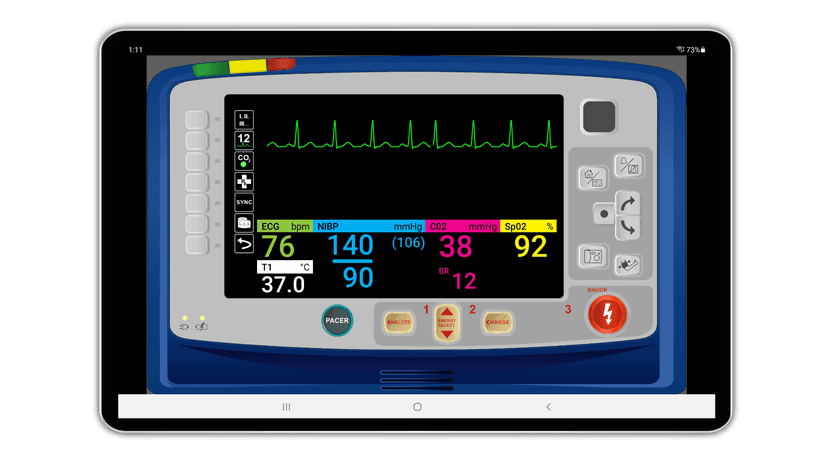
Advancing EMS Training: Why Modern Defibrillator Simulators Outperform Legacy Equipment
A comprehensive analysis of how modern defibrillator simulators address critical limitations of legacy training systems, enhancing EMS education quality and student preparedness for real-world emergency scenarios.
Read article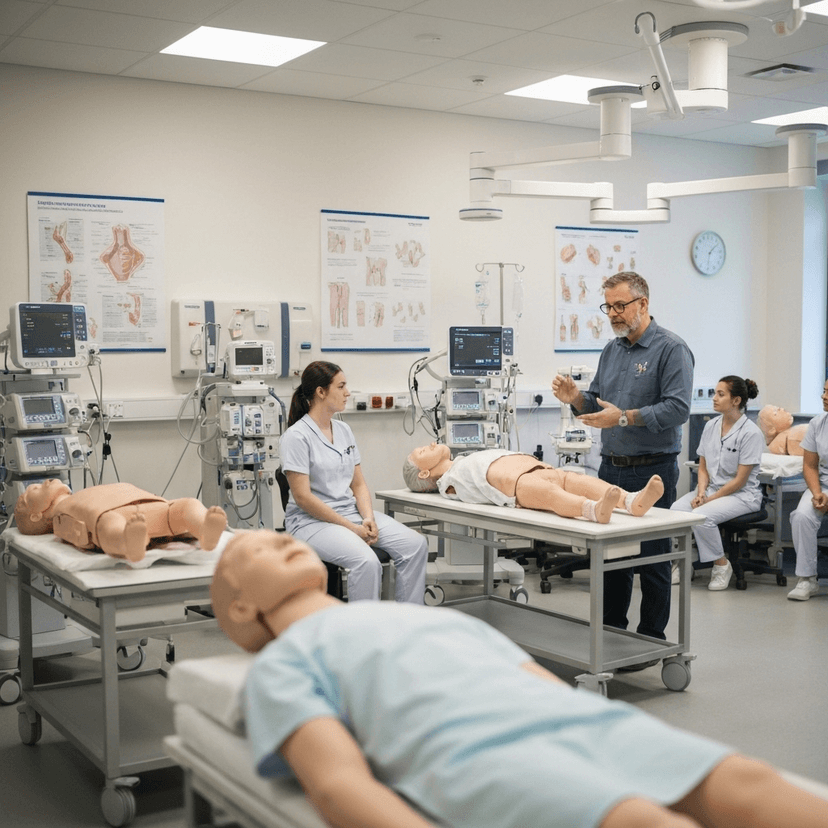
Nursing Education
From Novice to Expert: Building Clinical Readiness Through Progressive Simulation
Discover how progressive simulation transforms nursing education through a systematic 'crawl, walk, run' approach that builds genuine clinical competence and confidence from first semester through graduation.
Read article